TPO Roofing Installation Cost Per Square Foot: Metro Atlanta 2026
If you’re budgeting for a flat roof replacement on your Metro Atlanta commercial property, understanding TPO roofing installation cost per square foot Metro Atlanta 2026 is essential for accurate financial planning. You need real numbers—not vague “it depends” estimates that leave you guessing. TPO roofing installation cost per square foot in Metro Atlanta for 2026 ranges from $5.50 to $12, depending on membrane thickness, building complexity, and project scope. That’s a wide range, and understanding where your property falls within it can mean the difference between an accurate capital expense forecast and a budget-busting surprise. Commercial property owners throughout the region are actively seeking reliable pricing data to make informed decisions about their flat roof investments.
Whether you manage a warehouse in Cobb County, a retail center in Gwinnett, or an office park in Cherokee County, this guide breaks down current Metro Atlanta TPO pricing by membrane grade, identifies the hidden costs that inflate commercial roofing bids, and shows you how to evaluate contractor estimates with confidence. Pro Roofing & Siding has installed TPO systems on commercial properties throughout Metro Atlanta, and we’ve compiled this pricing guide based on current 2026 market conditions. By the end, you’ll know exactly what questions to ask and what costs to plan for when investing in your commercial flat roof installation.

2026 TPO Roofing Installation Cost Per Square Foot Metro Atlanta: Current Market Rates
Let’s cut to the numbers. For commercial roofing services involving TPO membrane systems in Metro Atlanta, property managers should budget within these ranges for 2026. Understanding the commercial TPO roof cost Atlanta property owners face helps you plan capital expenditures accurately and avoid unexpected budget overruns during your roofing project.
| TPO System Tier | Price Per Square Foot | Typical Applications |
|---|---|---|
| Budget (45-mil TPO) | $5.50 – $7.00 | Small retail spaces, temporary structures |
| Mid-Range (60-mil TPO) | $7.00 – $9.50 | Warehouses, office buildings, most commercial |
| Premium (80-mil TPO) | $9.50 – $12.00 | High-traffic roofs, rooftop equipment areas |
These figures include material, labor, and standard installation—but not significant tear-off, insulation upgrades, or extensive drainage work. Metro Atlanta’s commercial roofing market currently runs about 8-12% higher than national averages, reflecting strong construction demand and regional labor costs. The flat roof installation price Georgia commercial properties encounter reflects both the skilled labor requirements and the quality materials necessary for long-term performance in our Southeastern climate.
The good news for 2026 budgeting: TPO material prices have stabilized after the supply chain volatility of 2022-2024. Manufacturers like GAF, Carlisle, and Firestone have normalized production, and the extreme price swings we saw during the pandemic recovery have largely settled. That makes 2026 a more predictable year for commercial roof planning than the previous three years. Property managers can now forecast their roofing budgets with greater confidence, knowing that material costs are unlikely to spike unexpectedly during their project timeline.
For a 20,000 square foot warehouse, you’re looking at a realistic budget of $140,000 to $190,000 for a quality 60-mil TPO system with standard insulation. Premium installations with 80-mil membrane and enhanced warranty coverage push into the $190,000 to $240,000 range. These commercial roofing estimate Atlanta GA figures represent fully installed systems including labor, materials, and standard project requirements.

Key Factors That Affect Your TPO Roofing Installation Cost Per Square Foot Metro Atlanta 2026
Square footage gets you a starting point, but several factors move your actual project cost up or down the pricing scale. Understanding these variables helps you anticipate where your property falls before you request bids from a TPO membrane roofing contractor Metro Atlanta. Each commercial building presents unique challenges that influence final pricing, and being aware of these factors positions you for more productive conversations with potential contractors.
Roof size and complexity: Larger projects typically achieve better per-square-foot rates due to economies of scale. A 50,000 square foot warehouse will often quote at $6.50-$8.00 per square foot, while a 5,000 square foot retail space might quote at $8.00-$10.00 for the same membrane grade. However, complex roof layouts with multiple penetrations, level changes, or intricate parapet details increase labor time and materials, potentially offsetting size advantages. Buildings with numerous HVAC units, skylights, vents, and other roof-mounted equipment require additional flashing work and careful membrane integration around each penetration point.
TPO membrane thickness: The jump from 45-mil to 60-mil TPO adds roughly $1.00-$1.50 per square foot, while upgrading from 60-mil to 80-mil adds another $1.50-$2.50 per square foot. We’ll break down the warranty and performance implications of each thickness in the next section. The membrane thickness decision represents a balance between upfront investment and long-term performance expectations—a trade-off every commercial property owner must evaluate based on their ownership timeline and risk tolerance.
Existing roof condition: If your current roof can serve as a substrate for TPO overlay, you’ll save significantly on tear-off and disposal costs—often $1.50-$2.50 per square foot. However, Georgia building codes limit the number of roof layers, and moisture-damaged decking requires complete removal regardless. A thorough inspection with core sampling can reveal hidden moisture problems that would compromise a new installation if left unaddressed. Investing in proper substrate preparation protects your new TPO investment from premature failure.
Building height and access: A single-story warehouse with ground-level staging access is straightforward. A three-story office building requiring crane lifts, limited parking lot access, or occupied-building scheduling adds 10-20% to labor costs. Contact our team through a free commercial roof inspection to evaluate your specific access conditions. Buildings in congested commercial areas or those requiring work during specific hours to accommodate tenant operations face additional logistical challenges that impact overall project pricing.
Seasonal timing and scheduling: The timing of your TPO installation can influence both pricing and project efficiency. Late spring through early fall represents peak roofing season in Metro Atlanta, when contractor schedules fill quickly. Planning your project during shoulder seasons (late winter or late fall) may offer scheduling flexibility and potentially more competitive pricing, though weather considerations become more important. However, TPO installation requires temperatures above 40°F for proper membrane welding, so severe winter weather can delay projects.
TPO Membrane Options: Thickness, Warranty, and Price Tiers for Commercial Properties
Not all TPO is created equal. The membrane thickness you select directly impacts durability, warranty coverage, and long-term cost-effectiveness. Here’s what Metro Atlanta property managers need to know about each tier when evaluating their flat roof installation price Georgia options. Making the right membrane selection requires understanding how each thickness performs under real-world conditions and how manufacturer warranties protect your investment.
45-mil TPO represents the budget option, suitable for smaller buildings where initial cost outweighs long-term performance concerns. At $5.50-$7.00 per square foot installed, it’s the most affordable entry point. However, 45-mil systems typically carry only 10-year warranties and have thinner wear layers that degrade faster under Atlanta’s intense summer UV exposure. For temporary structures or properties planned for redevelopment within 10-15 years, 45-mil can make financial sense. This thickness is also appropriate for covered areas or secondary structures where exposure conditions are less demanding than primary building roofs.
60-mil TPO is the industry standard for most commercial properties in Metro Atlanta, representing the best balance of cost and performance. At $7.00-$9.50 per square foot installed, 60-mil systems carry 15-20 year manufacturer warranties depending on installation specifications. The additional membrane thickness provides better puncture resistance, weld integrity, and UV stability—important considerations for Georgia’s climate. Most TPO membrane roofing contractor Metro Atlanta professionals recommend 60-mil as the default specification for standard commercial applications because it delivers reliable performance without the premium cost of heavier membranes.
80-mil TPO targets high-performance applications: rooftops with frequent maintenance traffic, heavy HVAC equipment, or owners seeking maximum warranty protection. At $9.50-$12.00 per square foot, 80-mil systems qualify for 20-25 year No Dollar Limit (NDL) warranties when installed by certified contractors. For properties you plan to hold long-term, the premium investment reduces lifecycle costs. The thicker membrane provides superior resistance to mechanical damage, foot traffic, and weathering—making it the preferred choice for institutional buildings, corporate headquarters, and properties where roof reliability is mission-critical.
| Membrane Thickness | Typical Warranty | Best For | Metro Atlanta Price Range |
|---|---|---|---|
| 45-mil | 10 years | Budget projects, short-term holds | $5.50 – $7.00/sq ft |
| 60-mil | 15-20 years | Standard commercial applications | $7.00 – $9.50/sq ft |
| 80-mil | 20-25 years NDL | High-traffic, long-term ownership | $9.50 – $12.00/sq ft |
Understanding TPO Warranty Coverage and What It Means for Your Investment
Warranty coverage represents a critical component of your TPO roofing investment, yet many property owners don’t fully understand what their warranty actually covers. Manufacturer warranties vary significantly in their terms, exclusions, and practical value. A “20-year warranty” from one manufacturer may offer far less protection than a “15-year warranty” from another, depending on coverage terms and the financial backing behind the guarantee.
No Dollar Limit (NDL) warranties provide the strongest protection, covering the full cost of materials and labor for covered repairs or replacement without depreciation. Standard warranties often include prorated coverage that reduces the manufacturer’s obligation as the roof ages. For example, a prorated 20-year warranty might only cover 50% of repair costs after year 10. Understanding these distinctions helps you evaluate the true long-term value of different membrane options and contractor proposals.
Additionally, warranty coverage typically requires proper maintenance documentation. Most manufacturers require annual inspections and documentation of any repairs performed. Failing to maintain proper records can void warranty coverage when you need it most. Establishing a maintenance protocol from day one protects both your roof and your warranty rights.

TPO vs EPDM Cost Comparison: Making the Right Choice for Atlanta Properties
TPO isn’t the only flat roofing option for Metro Atlanta commercial properties. Understanding the TPO vs EPDM cost comparison helps you make an informed material decision based on your building’s needs and your budget constraints. Both materials have served commercial properties effectively for decades, but they perform differently under Georgia’s climate conditions and offer distinct advantages depending on your priorities.
TPO vs EPDM: Both single-ply membranes install at similar price points—$7.00-$10.00 per square foot for quality 60-mil systems. The key difference is reflectivity. TPO’s white surface reflects solar heat, reducing cooling loads during Atlanta’s brutal summers. EPDM (black rubber) absorbs heat, making it less energy-efficient for Georgia climates but often preferred for heating-dominated northern regions. For most Metro Atlanta commercial properties, TPO’s energy performance advantage outweighs EPDM’s slightly better puncture resistance. The reflective properties of TPO can significantly reduce rooftop surface temperatures, which translates directly into lower air conditioning costs for building occupants.
Installation method differences: TPO seams are heat-welded, creating a continuous, watertight bond that’s generally stronger than the adhesive or tape seams used in EPDM installations. Heat-welded seams also perform better under thermal cycling—an important consideration in Georgia where rooftop temperatures can swing 80°F or more between summer days and winter nights. However, EPDM’s flexibility makes it somewhat more forgiving on roofs with complex shapes or numerous penetrations.
Modified bitumen costs $6.00-$9.00 per square foot installed and provides superior puncture resistance for roofs with heavy foot traffic or equipment. It’s an excellent choice for industrial facilities, maintenance-intensive buildings, or properties where durability matters more than energy efficiency. However, the dark surface increases cooling costs compared to TPO. Modified bitumen systems also require torch application or hot asphalt in some configurations, which presents additional safety considerations during installation.
Energy efficiency impact: TPO’s reflective properties can reduce rooftop temperatures by 50-60°F compared to dark membranes. For a 30,000 square foot warehouse in Gwinnett County, this translates to meaningful annual cooling savings—often $3,000-$6,000 per year depending on HVAC efficiency and insulation levels. Over a 20-year roof lifecycle, energy savings can offset much of the initial installation cost difference. Some utility companies also offer rebates for reflective roofing installations, which can further improve the return on your TPO investment.
Long-term maintenance considerations: Both TPO and EPDM require regular inspections and maintenance, but their maintenance profiles differ. TPO’s heat-welded seams generally require less ongoing attention than EPDM’s adhesive seams, which can lift or separate over time. However, TPO is more susceptible to certain chemical exposures, so buildings with rooftop exhaust from commercial kitchens or manufacturing processes may need special considerations. Understanding these maintenance differences helps you budget accurately for ongoing roof care.
For most office buildings, retail centers, and warehouses in Metro Atlanta, TPO offers the best combination of upfront cost, energy performance, and long-term value. Modified bitumen remains the choice for high-abuse industrial environments where puncture resistance takes priority over energy efficiency.
Hidden Costs and Budget Considerations for Commercial TPO Projects
The per-square-foot price for TPO membrane installation tells only part of the story. Several additional costs regularly appear in commercial roofing projects, and failing to account for them leads to budget shortfalls. Here’s what property managers should anticipate when developing their commercial roofing estimate Atlanta GA budgets. Comprehensive planning requires understanding all potential cost categories, not just the membrane and basic installation labor.
Insulation upgrades: Georgia’s energy code requires minimum R-30 insulation for commercial roof assemblies. If your existing insulation is damaged, compressed, or below current code requirements, you’ll need to budget an additional $2.00-$4.00 per square foot for polyiso insulation replacement. Many buildings built before 2010 require insulation upgrades during re-roofing. Beyond code compliance, upgrading insulation during a roof replacement is highly cost-effective because labor costs for insulation installation are minimal when the roof membrane is already being replaced. Adding insulation after the roof is complete would require a separate project with separate mobilization costs.
Drainage modifications: Proper drainage is critical for flat roof performance. If your building has ponding water issues, adding tapered insulation, scuppers, or internal drains can add $1.50-$3.00 per square foot to your project. However, addressing drainage during installation prevents premature membrane failure and warranty issues. Ponding water—water that remains on the roof more than 48 hours after precipitation—accelerates membrane degradation and can void manufacturer warranties. Investing in proper drainage during installation protects your membrane investment for decades.
Roof penetrations: Every HVAC unit, vent pipe, skylight, and roof hatch requires proper flashing. A building with 15-20 penetrations adds significant labor time compared to a simple warehouse with minimal rooftop equipment. Expect $200-$500 per penetration for proper TPO integration. Complex penetrations like large rooftop units or curb-mounted equipment may cost more depending on configuration. Additionally, if your rooftop equipment is aging, coordinating HVAC replacement or upgrades during the roofing project can save money by avoiding future roof penetration work.
Edge metal and fascia: Commercial roofs require edge metal systems to terminate the membrane and protect against wind uplift. Existing edge metal may be reusable, but damaged or undersized systems need replacement. Budget $8-$15 per linear foot for new edge metal installation. Buildings with decorative fascia or architectural details require custom fabrication that increases costs further.
Permitting and inspections: Commercial roofing projects in Cobb, Gwinnett, and Cherokee Counties require building permits and inspections. Permit fees typically run $500-$2,000 depending on project size and municipality. Some jurisdictions also require engineering stamps for structural load verification. Our commercial roofing services team handles permit coordination throughout Metro Atlanta. We understand the specific requirements of each municipality and can navigate the permitting process efficiently to avoid project delays.
Temporary weather protection: Commercial buildings cannot simply go without a roof during installation. For projects requiring tear-off, temporary weather protection measures may be necessary—especially during Metro Atlanta’s unpredictable spring and summer storm seasons. This might include nightly tie-ins, temporary membrane sections, or accelerated scheduling to minimize exposure time. These measures add cost but protect your building interior and contents from water damage.
How to Get an Accurate TPO Roofing Estimate in Metro Atlanta
The best commercial roofing estimate starts with a thorough inspection—not a phone quote or satellite measurement. Here’s what a professional assessment should include and what questions to ask contractors when evaluating proposals for your TPO roofing installation cost per square foot Metro Atlanta 2026 project. Taking time to properly vet contractors and understand their proposals protects you from surprises and ensures you’re comparing equivalent specifications.
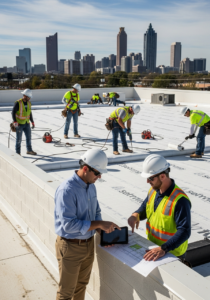
What the inspection should cover: A qualified commercial roofer will physically access your roof to evaluate current membrane condition, check for moisture in the insulation using infrared scanning or core samples, inspect flashing and penetration details, assess drainage patterns, and document any visible damage. This takes 1-2 hours for most commercial buildings. If a contractor quotes your project based solely on square footage from Google Earth, you’re not getting an accurate estimate. Comprehensive inspections reveal conditions that significantly impact pricing—moisture damage, deck deterioration, code compliance issues, and access challenges that aren’t visible from satellite imagery.
Core sampling importance: Moisture trapped in existing insulation is invisible from the roof surface but dramatically affects project scope. Core sampling—removing small sections of the roof assembly to inspect insulation conditions—is the most reliable way to assess substrate conditions. Thermal imaging can supplement core sampling by identifying areas of potential moisture intrusion that warrant further investigation. Any contractor who doesn’t perform some form of moisture assessment is providing an incomplete evaluation.
Questions to ask contractors:
- What membrane thickness and manufacturer are you specifying?
- Is tear-off included, or is this an overlay bid?
- What insulation R-value will the system achieve?
- Who holds the warranty—the manufacturer, your company, or both?
- Are permit fees and inspections included in this estimate?
- What is your labor warranty beyond the manufacturer’s coverage?
- How do you handle unexpected conditions discovered during installation?
- What is your project timeline, and how do you handle weather delays?
- Can you provide references from similar commercial projects?
Red flags in commercial bids: Beware of estimates that are significantly below market rates. A 20,000 square foot TPO bid at $80,000 should raise questions—either the contractor is using inferior materials, cutting corners on preparation, or planning to hit you with change orders mid-project. Also watch for vague scope descriptions like “re-roof building” without specifying membrane type, thickness, and warranty details. Legitimate contractors provide detailed, itemized proposals that clearly specify every component of the installation.
Comparing apples to apples: When evaluating multiple bids, ensure you’re comparing equivalent specifications. One contractor bidding 60-mil TPO with R-30 insulation shouldn’t be compared directly to another bidding 45-mil TPO with no insulation upgrade. Create a standardized comparison matrix that identifies membrane thickness, insulation specifications, warranty terms, and included services for each proposal.
Request detailed written proposals that specify every material, thickness, and warranty. Legitimate contractors welcome questions about their specifications.
Working with Insurance: TPO Replacement After Storm Damage
Metro Atlanta’s commercial properties regularly sustain storm damage from hail, high winds, and severe thunderstorms. When your TPO roof is damaged, understanding the insurance claim process helps you recover costs efficiently and ensures your commercial roofing estimate Atlanta GA accurately reflects covered damage.
When TPO damage qualifies for coverage: Commercial property insurance typically covers roof damage from named perils—hail, wind, fallen trees, and storm debris. Gradual wear and tear, poor maintenance, and age-related deterioration are generally excluded. If your TPO membrane shows punctures, tears, or seam failures following a documented storm event, you likely have a valid claim. Our storm damage restoration team documents damage for insurance purposes. Hail damage on TPO often appears as divots, fractures, or granule loss in the membrane surface, while wind damage typically manifests as lifted seams, torn flashing, or displaced sections.
Documentation requirements: Georgia insurers require thorough documentation for commercial roof claims. This includes date-stamped photographs of all damage areas, measurement diagrams showing affected sections, a detailed repair or replacement estimate, and evidence connecting damage to a specific weather event. Property managers should photograph roof conditions annually to establish baseline documentation. Having pre-storm photos demonstrating the roof’s condition before damage occurred strengthens your claim by proving the damage is storm-related rather than pre-existing.
How Pro Roofing & Siding supports commercial claims: We work directly with commercial property adjusters to document damage, explain repair requirements, and ensure claims reflect actual restoration costs. Our roof insurance claim assistance includes comprehensive photo documentation, written damage assessments, and adjuster meeting coordination when needed. We understand the documentation standards insurance companies require and provide thorough reports that support claim approval.
Timeline expectations: Insurance-covered TPO replacements typically take 4-8 weeks from claim filing to project completion. This includes adjuster scheduling (1-2 weeks), claim processing and approval (2-4 weeks), and installation scheduling (1-2 weeks). Storm seasons with widespread damage can extend these timelines significantly. Filing claims promptly after discovering damage helps avoid delays and ensures your claim is processed before insurance company backlogs develop.
Supplement claims: Initial insurance estimates often understate actual repair costs. If the adjuster’s assessment doesn’t cover the full scope of necessary repairs, experienced contractors can prepare supplement documentation requesting additional coverage. This is a normal part of the commercial claims process, not adversarial—adjusters often appreciate detailed documentation that clarifies repair requirements.

Frequently Asked Questions About TPO Roofing Installation Cost Per Square Foot Metro Atlanta 2026
How much does TPO roofing cost per square foot for a 20,000 sq ft commercial building in Atlanta?
For a 20,000 square foot commercial building in Metro Atlanta, expect to pay $7.00-$9.50 per square foot for a quality 60-mil TPO system, translating to a total project cost of $140,000-$190,000. This assumes standard complexity, adequate existing insulation, and no major drainage modifications. Premium 80-mil systems or buildings requiring extensive tear-off and insulation replacement will push costs toward $200,000-$240,000. These TPO roofing installation cost per square foot Metro Atlanta 2026 figures represent realistic budget ranges for properly specified commercial installations.
Is 60-mil or 80-mil TPO worth the extra cost for my commercial property?
For most Metro Atlanta commercial properties, 60-mil TPO provides the best value—adequate durability, 15-20 year warranty coverage, and competitive pricing. Upgrade to 80-mil if your roof sees regular maintenance traffic, supports heavy HVAC equipment, or if you plan to hold the property for 20+ years and want maximum warranty protection. The $2.00-$2.50 per square foot premium for 80-mil adds up quickly on large buildings but can be justified for long-term ownership scenarios. Consider the total cost difference: on a 25,000 square foot building, upgrading to 80-mil adds $50,000-$62,500 to your project but may extend useful life by 5-10 years.
How long does TPO roofing last in Georgia’s climate?
Quality TPO roofing systems installed by certified contractors typically last 20-30 years in Georgia’s climate. The primary degradation factors are UV exposure and thermal cycling—both significant in Metro Atlanta. Higher membrane thickness (60-mil or 80-mil) and proper installation techniques extend service life. Poorly installed systems or budget 45-mil membranes may only achieve 12-15 years before requiring replacement. Regular maintenance, including annual inspections and prompt repair of any damage, helps maximize the useful life of your TPO roof investment.
Can I install TPO over my existing flat roof to save money?
In some cases, yes. If your existing roof has only one membrane layer, the decking is structurally sound, and moisture testing shows no wet insulation, TPO overlay can save $1.50-$2.50 per square foot compared to complete tear-off. However, Georgia building codes limit total roof layers, and hiding moisture problems under a new membrane accelerates deck deterioration. A proper inspection with core sampling determines whether overlay is appropriate for your building. Overlay installations also add weight to your roof structure, which must be considered for buildings near their structural load limits.
Does TPO roofing qualify for commercial energy efficiency tax credits in 2026?
TPO roofing systems that meet ENERGY STAR reflectivity standards may qualify for federal commercial building energy efficiency deductions under Section 179D. The deduction value depends on total building energy improvement performance. Consult your tax professional about specific qualification requirements and documentation. Pro Roofing & Siding provides product specification documentation showing reflectivity and emissivity ratings for installed TPO systems. Additionally, some Georgia utility companies offer rebates for reflective roofing installations that reduce peak cooling demand—check with your utility provider about available incentive programs.
What warranty should I expect from a TPO roofing contractor in Metro Atlanta?
Expect both manufacturer and contractor warranties. Manufacturer warranties from GAF, Carlisle, or Firestone typically range from 15-25 years depending on membrane thickness and installation certification level. Separately, your contractor should provide a labor warranty covering workmanship defects—typically 5-10 years. Ensure both warranties are provided in writing before project commencement, with clear coverage terms for leaks, seam failures, and flashing defects. Understanding the difference between prorated and No Dollar Limit warranties helps you evaluate the true protection each option provides.
How do I find a qualified TPO membrane roofing contractor in Metro Atlanta?
Look for contractors with manufacturer certifications (such as GAF Master Elite or Carlisle Authorized Applicator status), documented commercial project experience, proper licensing and insurance, and verifiable references from similar projects. Manufacturer certifications indicate the contractor has met specific training and quality requirements that qualify them to offer enhanced warranty programs. Request proof of both general liability and workers’ compensation insurance, and verify the contractor is licensed by the Georgia Secretary of State for commercial construction work.
What is the best time of year to schedule TPO roofing installation in Metro Atlanta?
The optimal window for TPO roofing installation cost per square foot Metro Atlanta 2026 projects falls between late March and early November. TPO membrane requires temperatures above 40°F for proper heat welding, making deep winter months challenging for quality installations. Spring and fall offer moderate temperatures and lower humidity, creating ideal welding conditions. However, these seasons also represent peak demand periods, so scheduling 4-6 weeks in advance is advisable. Summer installations are common but require crews to manage heat stress and work during cooler morning hours when possible.
Why Choose Pro Roofing & Siding for Your Commercial TPO Project
Selecting a commercial roofing contractor involves more than comparing bids. You need a team with documented Metro Atlanta experience, proper manufacturer certifications, and a track record of satisfied commercial clients. When evaluating contractors for your TPO roofing installation cost per square foot Metro Atlanta 2026 project, the contractor’s qualifications and experience directly impact both project quality and long-term roof performance.
Pro Roofing & Siding brings:
- 4.8-star rating with 282+ reviews from property managers, business owners, and HOA boards throughout Metro Atlanta
- GAF Master Elite certification—a designation held by only 3% of roofing contractors, enabling us to offer enhanced manufacturer warranties
- Commercial project experience across Cobb, Cherokee, and Gwinnett Counties, including warehouses, retail centers, office buildings, and apartment complexes
- Insurance claim expertise for storm-damaged commercial roofs, with adjuster coordination and documentation support
- Transparent pricing based on thorough inspections—no lowball bids followed by change orders
- Dedicated project management ensuring clear communication throughout your commercial roofing project
We understand that commercial property managers and building owners need accurate budgeting information, clear project timelines, and minimal disruption to tenants and operations. Every commercial TPO project begins with a detailed inspection and a written proposal specifying membrane grade, insulation specifications, and warranty terms. Our team coordinates with building occupants and property management to schedule work efficiently while minimizing operational disruptions.
As a leading TPO membrane roofing contractor Metro Atlanta property owners trust, we bring both technical expertise and practical project management skills to every installation. Our crews are trained specifically in commercial flat roof systems and understand the unique requirements of occupied commercial buildings, including coordinating around business hours and maintaining clean, safe work areas.
Get Your Free Commercial Roof Inspection Today
Accurate TPO roofing cost estimates start with understanding your building’s specific conditions—not generic per-square-foot assumptions from a website. If you’re planning a flat roof replacement for a Metro Atlanta commercial property in 2026, let our team provide a detailed inspection and written proposal at no cost.
We’ll assess your current roof condition, check for moisture damage, evaluate drainage