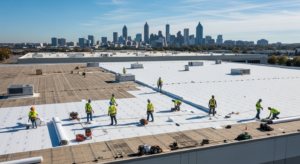
TPO vs EPDM Roofing for Apartment Complexes in Georgia
When you’re managing an apartment complex in Metro Atlanta, your roof isn’t just a building component—it’s a capital asset that directly impacts your operating costs, tenant satisfaction, and property value. Choosing between TPO vs EPDM roofing for apartment complexes in Georgia requires more than comparing spec sheets. You need to understand how each system performs under Georgia’s punishing summer heat, humidity that promotes mold growth, and severe storms that can strike from March through November. The wrong choice can mean premature replacement, higher energy bills, and insurance headaches that eat into your NOI. The right choice protects your investment for decades. This guide breaks down the real costs, performance differences, and business considerations that property managers and apartment owners in Cobb, Cherokee, and Gwinnett Counties actually face when replacing flat roofs on multifamily properties. Whether you’re planning a capital expenditure for next year or dealing with a roof that’s already failing, you’ll leave with a clear framework for making this decision.
Understanding Flat Roof Systems for Georgia Apartment Complexes
Apartment complexes across Metro Atlanta predominantly use flat or low-slope roofing systems for practical reasons. These roofs maximize usable building footprint, simplify HVAC equipment placement, and cost less to install per square foot than pitched alternatives. For a 200-unit apartment complex, flat roofing can reduce construction costs by 15-20% compared to traditional pitched systems—savings that translate directly to better returns on your investment.
However, flat roofs face unique challenges in Georgia’s climate. Summer temperatures regularly exceed 95°F, with roof surface temperatures climbing past 150°F on dark-colored membranes. This thermal stress accelerates material degradation. Add Metro Atlanta’s average 50 inches of annual rainfall, humidity levels that hover around 70%, and an active severe storm season, and you have conditions that test every roofing system’s limits.
Property managers evaluating flat roof replacement should focus on four performance metrics that directly impact the bottom line. First, expected lifespan under Georgia conditions—not manufacturer claims based on ideal environments. Second, maintenance requirements and costs over a 20-year ownership period. Third, energy efficiency and its impact on cooling costs across your units. Fourth, how each system handles the storm damage that’s inevitable in this region.
Single-ply membrane roofing dominates the commercial market because these systems deliver predictable performance at competitive costs. TPO and EPDM represent the two leading options for multifamily properties, each with distinct advantages depending on your priorities and budget constraints.
What Is TPO Roofing? Advantages for Multifamily Properties
TPO (thermoplastic polyolefin) roofing has become the fastest-growing commercial roofing material in the United States over the past two decades. This single-ply membrane combines polypropylene and ethylene-propylene rubber polymers with reinforcing polyester scrim for durability. For apartment complex owners, TPO offers several advantages worth considering in your capital planning.
Energy efficiency stands out as TPO’s primary selling point. The standard white membrane reflects up to 90% of solar radiation, keeping roof surface temperatures dramatically lower than dark-colored alternatives. In Georgia’s climate, this translates to measurable savings. Property managers typically report 15-25% reductions in cooling costs after switching to TPO from darker roofing materials. For a 150-unit complex spending $80,000 annually on HVAC, that’s $12,000-$20,000 in yearly savings that compounds over the roof’s lifespan.
Installation quality matters enormously with TPO, and the heat-welded seam technology provides a significant advantage for Georgia properties. Installers use hot-air welding to fuse membrane sheets together, creating seams that are actually stronger than the membrane itself. These welded seams resist the ponding water common on large flat roofs and maintain integrity through the thermal cycling that occurs during Georgia’s 60-degree temperature swings between summer days and winter nights.
When properly installed by a qualified commercial roofing contractor, TPO systems deliver 20-30 years of service life. Manufacturer warranties typically range from 15-25 years depending on thickness and installation specifications. For property managers planning long-term holds, TPO’s combination of durability and energy savings often delivers the strongest return on investment.
What Is EPDM Roofing? Benefits for Apartment Buildings
EPDM (ethylene propylene diene monomer) rubber roofing has protected commercial buildings for over 50 years, giving property managers something TPO cannot offer: a multi-decade track record of proven performance. This synthetic rubber membrane has been tested by time across millions of square feet of commercial roofing, including thousands of apartment complexes throughout the Southeast.
The material’s flexibility gives it distinct advantages in Metro Atlanta’s temperature fluctuations. EPDM maintains elasticity from -40°F to 300°F, easily handling the thermal stress that Georgia roofs experience. This flexibility also allows EPDM to accommodate building movement and settling without cracking—important for older apartment buildings that may have structural shifting over time.
For budget-conscious property managers, EPDM’s lower initial installation cost often tips the decision. Material and labor costs typically run 15-25% below TPO for equivalent coverage. On a 50,000 square foot apartment complex roof, this difference can represent $25,000-$50,000 in upfront savings. If you’re managing multiple properties or working within strict capital expenditure limits, EPDM allows you to address more roofing needs with available funds.
EPDM installation can be completed using several methods: fully adhered, mechanically attached, or ballasted with stone. Each approach offers different cost and performance tradeoffs. Mechanically attached systems typically cost less and work well in Georgia, while fully adhered installations provide superior wind uplift resistance for properties in high-wind zones. The installation flexibility means contractors can often work around existing HVAC equipment and penetrations more efficiently than with TPO systems.
TPO vs EPDM: Direct Cost Comparison for Georgia Properties
Smart capital allocation requires understanding true costs, not just installation prices. Here’s how TPO and EPDM compare across the metrics that affect your property’s financial performance:
| Cost Factor | TPO Roofing | EPDM Roofing |
|---|---|---|
| Material cost per sq ft | $5.50 – $8.50 | $4.50 – $7.00 |
| Installed cost per sq ft | $7.00 – $12.00 | $5.50 – $9.50 |
| 50,000 sq ft complex (total) | $350,000 – $600,000 | $275,000 – $475,000 |
| Annual maintenance estimate | $0.05 – $0.10/sq ft | $0.08 – $0.15/sq ft |
| Expected lifespan (Georgia) | 20 – 30 years | 20 – 25 years |
| Energy savings (cooling) | 15 – 25% reduction | Minimal impact |
These figures reflect current Metro Atlanta market conditions. Your actual costs will vary based on roof complexity, access issues, existing damage, and project timing. The key insight for property managers: EPDM wins on upfront cost, but TPO often delivers better lifecycle economics when energy savings are factored in.
Insurance considerations also affect your analysis. Some carriers offer premium reductions for impact-resistant or fire-rated roofing systems. TPO generally earns better fire ratings than EPDM, potentially qualifying for small premium reductions. Additionally, warranty-backed installations from certified contractors can positively influence your property’s insurability. Our team provides roof insurance claim assistance and can help you understand how each option affects your coverage.
Georgia-Specific Performance Factors Property Managers Must Consider
National roofing comparisons often miss the regional factors that determine real-world performance. Georgia’s climate creates specific challenges that property managers must weigh when choosing between TPO and EPDM systems.
UV Exposure and Heat: Georgia ranks among the highest UV exposure states in the Southeast. TPO’s reflective surface dramatically outperforms black EPDM in heat rejection, with surface temperature differences of 50-70°F on summer afternoons. This difference affects not just energy costs but material longevity—lower temperatures mean slower degradation. However, white EPDM is available at premium pricing for properties wanting EPDM’s characteristics with improved reflectivity.
Storm Resistance: Metro Atlanta experiences an average of 2-3 significant hail events annually, plus tropical storm remnants that bring sustained high winds. TPO membranes are generally more puncture-resistant than EPDM, handling hail impact better. However, EPDM’s flexibility allows it to absorb impact energy without tearing. For wind uplift, both systems perform similarly when properly installed—the attachment method matters more than membrane type.
Ponding Water: Large flat roofs inevitably experience some ponding, and Georgia’s intense rainfall creates more pooling than drier climates. TPO’s heat-welded seams resist water intrusion better than EPDM’s adhesive or tape-sealed seams over time. If your complex has known drainage issues, TPO offers superior protection against leak development.
Humidity and Mold: Georgia’s humidity promotes biological growth on roofing surfaces. TPO’s smoother surface resists algae and mold better than EPDM’s textured finish. Algae growth isn’t just aesthetic—it retains moisture against the membrane and accelerates degradation. Properties surrounded by trees or with shade on portions of the roof should factor this maintenance consideration into their decision.
Which Roofing System Fits Your Apartment Complex?
Choosing between TPO and EPDM comes down to matching the right system to your property’s specific situation and your investment strategy. Here’s how to think through the decision:
Choose EPDM when:
- Upfront capital preservation is your primary concern
- You’re planning to sell the property within 5-7 years
- The existing roof deck is in excellent condition with minimal prep needed
- Your property has extensive rooftop equipment requiring frequent service access
- Energy costs are relatively low compared to other operating expenses
Choose TPO when:
- Long-term ownership is planned (10+ years)
- Energy efficiency is a priority for marketing or ESG reporting
- The property faces significant heat load from sun exposure
- You want maximum storm damage resistance
- HOA or investor reporting emphasizes sustainability metrics
Building age matters too. Older apartment complexes may have structural limitations that affect which systems can be installed. TPO installations sometimes require additional insulation or cover boards, adding cost and weight. EPDM’s flexibility makes it more forgiving on irregular or aging roof decks. A thorough inspection by an experienced commercial contractor will reveal any structural considerations affecting your options. Schedule a free inspection to understand your specific situation.
Working With a Commercial Roofing Contractor in Metro Atlanta
Your roofing system is only as good as its installation. For multifamily properties, contractor selection directly impacts your investment’s performance over the next 20-30 years. Here’s what property managers should evaluate:
Experience with multifamily properties: Ask specifically about apartment complex projects similar to yours in size and complexity. Request references from property management companies, not just building owners. A contractor experienced with commercial properties understands the coordination challenges of working around occupied units, managing tenant notifications, and minimizing disruption.
Manufacturer certifications: Both TPO and EPDM manufacturers offer certification programs for installers. These certifications matter because manufacturer warranties are often contingent on installation by certified contractors. GAF Master Elite certification, for example, is held by only 3% of roofing contractors and requires ongoing training and quality standards. Uncertified installations may leave you with reduced warranty protection.
Local Georgia experience: Code requirements, permit processes, and inspection standards vary across Metro Atlanta jurisdictions. A contractor familiar with Cobb County requirements may navigate permits faster than one learning the local process. Local experience also means understanding Georgia-specific performance factors discussed earlier.
Insurance and documentation: Commercial roofing contractors should carry substantial liability coverage and workers’ compensation. Request certificates of insurance naming your property as additionally insured. For apartment complexes, proper documentation of the installation also matters for future insurance claims and property transactions.
Why Choose Pro Roofing & Siding?
Pro Roofing & Siding has served Metro Atlanta’s commercial property owners with commercial roofing services built on expertise, transparency, and reliable execution. Our team understands the specific challenges multifamily properties face—from coordinating around occupied units to meeting HOA documentation requirements.
With a 4.8-star rating from 282+ reviews, our reputation reflects consistent quality across residential and commercial projects throughout Cobb, Cherokee, and Gwinnett Counties. As a GAF Master Elite certified contractor, we offer enhanced warranty options and installation standards that protect your investment.
We provide detailed proposals that break down costs transparently, so you can make informed capital allocation decisions. Our commercial team handles permit coordination, insurance documentation, and project scheduling to minimize disruption to your tenants and staff. Whether you need emergency repairs, planned replacement, or a second opinion on a contractor bid, we deliver straightforward assessments focused on your property’s best interests.
Frequently Asked Questions
How long does a TPO roof last on an apartment complex in Georgia?
TPO roofing systems typically last 20-30 years on Georgia apartment complexes when properly installed and maintained. Georgia’s intense UV exposure and severe storms can reduce lifespan compared to milder climates. Annual inspections and prompt repair of any damage help maximize service life. Quality of installation significantly impacts longevity—certified contractor installations with proper seam welding consistently outperform budget installations.
Is EPDM or TPO better for hurricane and hail resistance?
TPO generally offers better puncture resistance against hail impact due to its thermoplastic composition. For wind resistance, both systems perform comparably when properly installed with appropriate attachment methods. The critical factor is installation quality and attachment system rather than membrane type. Properties in high-wind zones should discuss enhanced attachment specifications with their contractor regardless of membrane choice.
What is the cost per unit to replace an apartment complex roof?
For Metro Atlanta apartment complexes, budget approximately $2,500-$5,000 per unit for complete flat roof replacement, depending on roof complexity and material choice. A 100-unit complex typically requires 40,000-60,000 square feet of roofing. EPDM installations fall at the lower end of this range, while premium TPO systems with enhanced warranties reach the higher end. Your actual per-unit cost depends on building layout, access conditions, and existing roof condition.
Can I install TPO over an existing EPDM roof?
Yes, TPO can often be installed over existing EPDM roofing if the underlying system is in acceptable condition. This “recover” approach saves tear-off and disposal costs while adding a second layer of protection. However, Georgia building codes limit total roof layers, and the existing EPDM must be inspected for moisture damage. A wet or deteriorated substrate requires removal before new installation. Our team can assess whether recover makes sense for your property.
Does TPO roofing qualify for energy efficiency rebates in Georgia?
TPO roofing may qualify for utility rebates and tax incentives when meeting specific reflectivity standards. Georgia Power has offered commercial efficiency incentives that sometimes include cool roofing. Federal tax provisions for commercial building efficiency may also apply. The landscape changes annually, so verify current programs with your utility provider and tax advisor. We can provide documentation of membrane specifications needed for rebate applications.
How often should flat roofs on apartment buildings be inspected?
Commercial flat roofs should be professionally inspected twice annually—typically spring and fall—plus after any significant storm event. Spring inspections catch winter damage before summer heat stress, while fall inspections ensure drainage systems are clear before heavy rains. For apartment complexes, regular inspection also provides documentation supporting insurance claims and property condition reporting for investors or lenders.
Get a Free Commercial Roof Inspection
Making the right roofing decision for your apartment complex starts with understanding your current roof’s condition and your property’s specific needs. Pro Roofing & Siding offers complimentary commercial roof inspections throughout Metro Atlanta, including Cobb, Cherokee, and Gwinnett Counties.
Our assessment includes documented photos of roof condition, identification of any existing damage or concerns, and honest recommendations based on your property’s situation and your investment goals. We’ll provide detailed proposals for both TPO and EPDM options so you can compare true costs and make an informed capital decision.
Call our commercial team at (770) 415-2297 or contact us online to schedule your inspection. We respond to commercial inquiries within one business day and can typically schedule inspections within the week. Whether you’re planning a replacement, investigating a potential leak, or simply want an expert evaluation of your roof’s remaining life, we’re here to provide the straight answers property managers need.